Tag Archives: Hyundai

Hyundai Tops J.D. Power Tech Index—Again. Here’s Why That Matters

For the sixth year running, Hyundai Motor Company has taken home the title of top mass-market brand for technology innovation in J.D. Power’s 2025 U.S. Tech Experience Index (TXI) Study. That kind of streak isn’t just bragging rights—it’s proof the Korean automaker has built a playbook for rolling out useful tech that everyday drivers actually want to use.

Now in its tenth year, the TXI Study ranks automakers on how effectively they launch new features, weighing innovation, execution, and customer-perceived value. And while plenty of brands are stuffing vehicles with cutting-edge hardware, Hyundai has managed to stand out by prioritizing technology that feels intuitive rather than intimidating.

Take the redesigned 2025 Hyundai Santa Fe, which pulled in multiple awards in this year’s study. The SUV scored hardware wins for both Driver Assist and Connected Vehicle tech, largely thanks to two features that punch above their weight in real-world usability: the company’s phone-based Digital Key system and the Blind-Spot View Monitor.

The Digital Key—now in its second generation and branded Digital Key 2 Premium—lets owners ditch the fob altogether. Instead, access is handled via a smartphone app leveraging Near-Field Communication (NFC), Ultra-Wideband (UWB), and Bluetooth Low Energy (BLE). Translation: walk up to your Santa Fe with your phone in your pocket, and the car unlocks itself. Start it, share access with a family member, even hand off digital credentials to a friend—all without passing around a physical key.

Then there’s the Blind-Spot View Monitor, a feature that still feels like a party trick even though Hyundai has been refining it for years. Click on your blinker, and a live feed from side-mounted cameras takes over the instrument cluster, showing you exactly what’s hiding in your blind spot. Whether it’s a cyclist in the city or a crossover hanging out in your left lane on the interstate, the system gives drivers an extra set of eyes—and more importantly, extra confidence.

Individually, neither feature is industry-exclusive. But the way Hyundai integrates them across trims, polishes the user experience, and listens to customer feedback is what keeps the brand at the top of J.D. Power’s innovation scoreboard. While luxury automakers often debut flashy, high-cost tech that trickles down years later, Hyundai has carved out a different niche: democratizing advanced features so that a wider audience actually gets to use them.

And that’s the real story here. In an industry where “innovation” is often synonymous with “expensive add-on,” Hyundai is proving that mass-market doesn’t have to mean second-best.

Source: Hyundai

Hyundai’s Bold Hydrogen Play: The All-New Nexo Debuts at the ESWC 2025

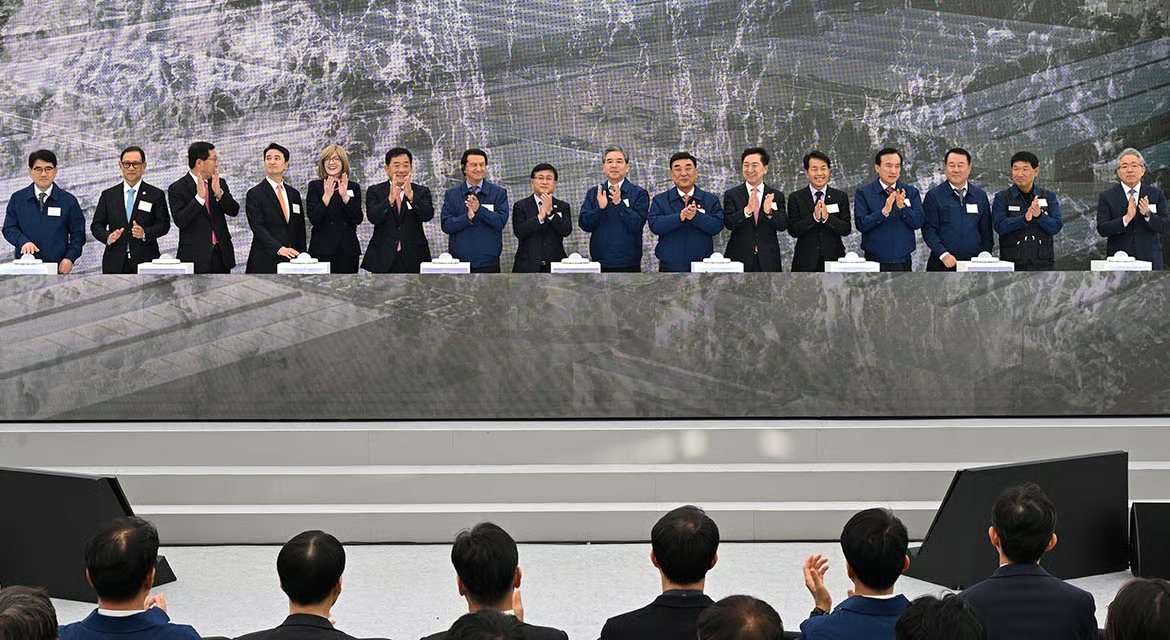
At most auto shows, you expect the usual parade of concept EVs, super-SUVs, and the latest take on “sustainable luxury.” But this wasn’t an auto show—it was the 13th World Congress of the Econometric Society (ESWC 2025) in Seoul, a gathering better known for academic papers and policy debates than for sheet metal reveals. Yet Hyundai Motor Company seized the stage to showcase its latest vision of a hydrogen-powered future, headlined by the world premiere of the all-new Nexo fuel cell electric vehicle (FCEV).

This marks the first full redesign of the Nexo in seven years, and Hyundai clearly wanted to make a statement. Built around the company’s new Art of Steel design philosophy, the Nexo wears a sharper, more aerodynamic silhouette highlighted by distinctive “HTWO” signature lamps—a nod to Hyundai Motor Group’s dedicated hydrogen sub-brand. Underneath, the engineering advances are more impressive still: Hyundai claims a driving range of more than 700 kilometers (435 miles) on a full tank of hydrogen and a total system output of 190 kW (255 horsepower). That’s a meaningful bump over the outgoing model, pushing the Nexo firmly into competitive territory with battery-electric SUVs while still offering the ultra-fast refueling that hydrogen advocates tout as the technology’s ace in the hole.

Inside, Hyundai doubles down on sustainability with materials derived from bio-based and recycled sources, while enhanced safety tech rounds out the package. The Nexo isn’t just a science project anymore—it’s designed to feel like a legitimate contender in the mainstream crossover market.

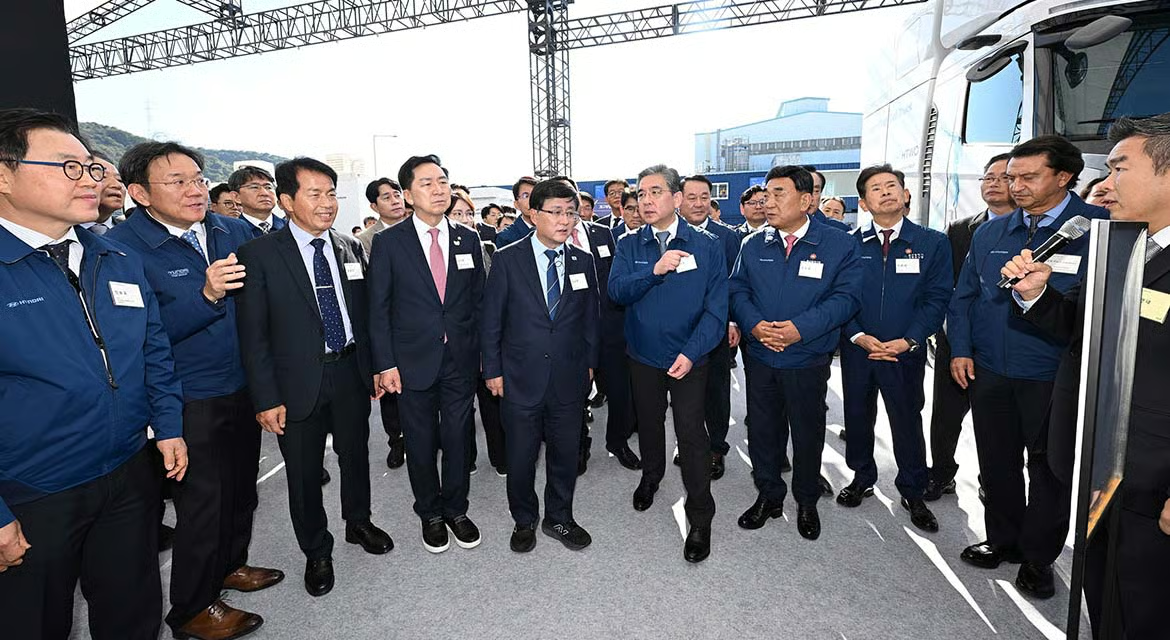
But Hyundai’s ambitions stretch well beyond a single vehicle. Through HTWO, the brand’s hydrogen-focused business platform, the automaker used the ESWC stage to illustrate its full-circle hydrogen ecosystem. Visual content and interactive displays showed off projects like the Chungju waste-to-hydrogen plant, which uses biogas for hydrogen extraction, and the Buan electrolysis facility, designed to scale clean hydrogen production. Together, these initiatives underscore Hyundai’s attempt to cover the entire value chain: production, storage, distribution, and utilization.

The company also highlighted its expanding lineup of hydrogen-powered commercial vehicles. The XCIENT Fuel Cell truck, already deployed in select international markets, took the spotlight alongside the Elec City and Universe Fuel Cell buses. If the Nexo is Hyundai’s consumer-facing proof of concept, these heavy-duty workhorses demonstrate the scalability—and real-world practicality—of hydrogen propulsion.

That Hyundai chose the World Congress of the Econometric Society as its stage is no accident. The event is held only once every five years and draws global leaders in economics and policy. Hyundai’s presence sent a clear message: hydrogen mobility isn’t just a matter of engineering; it’s a matter of economics, infrastructure, and global energy policy.

While battery-electric vehicles dominate the conversation today, Hyundai is betting big that hydrogen will play a pivotal role in the long-term transition to sustainable mobility. By positioning HTWO as an “open platform” for partnerships, investment, and collaboration, the automaker hopes to attract the allies—and capital—needed to build out the infrastructure that hydrogen requires.

For now, though, it’s the new Nexo that steals the headlines. Sleeker, stronger, and more sustainable, it may just be the most convincing argument yet that hydrogen fuel cell vehicles deserve a place in the automotive future.

Source: Hyundai

Hyundai Tucson Reinvented: Less Crossover, More Power Stance

If you thought the Hyundai Tucson was content with being the world’s dependable, value-packed family chariot, think again. Hyundai’s best-seller is about to shed its soft edges and bulk up like it’s just discovered creatine. The fifth-generation Tucson is coming, and this time, it’s raiding the Santa Fe’s wardrobe.

The big news? Hyundai’s giving it the brand’s new ‘Art of Steel’ design language – which is less about stainless kitchenware and more about turning everyday SUVs into Tonka toys for grown-ups. We’ve already seen this aesthetic on the big, blocky Santa Fe and the hydrogen-snorting Nexo. Both look like they were designed with the aid of Lego Technic and an angle grinder, and the Tucson is set to follow suit.

Spy shots of camouflaged prototypes reveal a longer bonnet, chunkier wheel arches, and a more upright stance. Translation: the Tucson’s been skipping Pilates and is now squatting heavy. It’s less crossover, more compact off-roader cosplay. Hyundai design boss Simon Loasby says he wants each model to be like “chess pieces” rather than “Russian dolls.” Which means your Tucson won’t just look like a shrunken Santa Fe – it’ll have its own swagger.

Inside, Hyundai promises its next-gen interior treatment, which could mean a dial-back on the mega-iPad dashboards we’ve all been pretending to love. Expect a slightly smaller screen, simpler software, and – hallelujah – more physical buttons. Hyundai’s design gurus reckon this is safer, but really, it’s because we’re all tired of playing touchscreen whack-a-mole while trying to change the fan speed.

Under the bonnet, things will be familiar but electrified. The Santa Fe’s 1.6-litre hybrid with 212 hp will likely make the cut, alongside a 249 hp plug-in hybrid for those who like their commutes with a side of smug. Four-wheel drive will be available, but don’t expect it to suddenly morph into a Dakar contender – this is still a school-run assassin first and foremost.

Practicality? Bigger body, more space, and possibly an upgrade from the already cavernous 620-litre boot. So yes, Karen, you’ll have room for the dog, the pushchair, and four crates of oat milk.

The Tucson matters because it’s Hyundai’s biggest player globally – shifting 600,000 units last year alone. It’s the car that’s allowed Hyundai to go from being the sensible budget option to stealing sales straight from Volkswagen and BMW’s lunch table.

So, when’s it coming? Expect the all-new Tucson to land in the second half of next year. And when it does, prepare for Hyundai’s middleweight SUV to look a lot more like it belongs in the ring.

Source: Hyundai