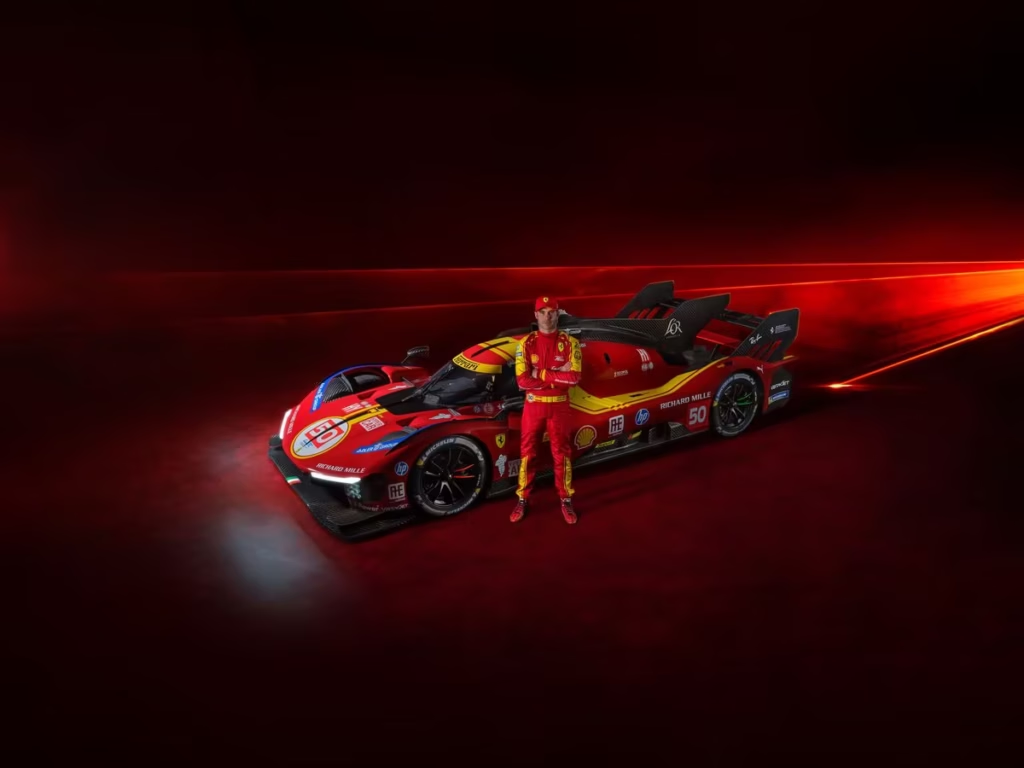
Ferrari has taken another significant step toward the future of its FIA World Endurance Championship programme, completing a crucial two-day development test with the 499P at Monza ahead of the 2027 season.

The Italian manufacturer brought its Le Mans-winning Hypercar to the 5.793-kilometre Autodromo Nazionale Monza, where factory drivers Antonio Fuoco, Antonio Giovinazzi, Alessandro Pier Guidi and Miguel Molina rotated behind the wheel as Ferrari continued the next phase of the 499P’s technical evolution.
The Monza test was not a simple shakedown. Instead, it represented the opening chapter of Ferrari’s 2027 development programme, with engineers evaluating a broad range of technical and aerodynamic solutions before final homologation in the coming months.
Ferrari 499P testing at Monza focuses on 2027 development
Ferrari confirmed that the programme centred on the evaluation, testing and validation of multiple technical configurations. The team is intentionally keeping several design options open as it works toward the final specification of the 2027 Ferrari 499P.
This gradual approach allows Ferrari to compare different aerodynamic packages and technical solutions under real track conditions, ensuring that the most promising concepts can be refined before homologation is locked in.
The Monza test therefore offers an early glimpse of the future Ferrari Hypercar that will compete in the FIA World Endurance Championship from 2027 onward.
Le Mans-winning Ferrari 499P enters a new chapter
Since making its FIA WEC debut at Sebring in 2023, the Ferrari 499P has established itself as one of endurance racing’s benchmark machines.

Its achievements include:
- Seven overall victories
- Three consecutive wins at the 24 Hours of Le Mans
- Twenty-four podium finishes
- Nine pole positions
- FIA World Endurance Manufacturers’ Championship title in 2025
- FIA World Endurance Drivers’ Championship title in 2025
Those results underline the extraordinary competitiveness of the 499P and explain why Ferrari is investing heavily in maintaining its advantage as the Hypercar category continues to evolve.
Ferrari’s world champions lead the Monza test
The second day of running featured reigning FIA WEC Drivers’ Champions Alessandro Pier Guidi and Antonio Giovinazzi, alongside Miguel Molina. The trio were instrumental in Ferrari’s 2025 Manufacturers’ Championship success and remain central figures in the factory endurance programme.
Their extensive experience with the 499P provided Ferrari engineers with valuable feedback during the assessment of new components and aerodynamic concepts.
Having championship-winning drivers involved at this stage is particularly important, as endurance racing development relies heavily on detailed driver feedback regarding balance, tyre behaviour, braking stability and aerodynamic efficiency.
Ferrari also prepares for the 2026 Monza 6 Hours
In addition to the future-focused development car, Ferrari also had its current 2026-specification 499P on track. That car completed a separate preparation programme ahead of the Monza 6 Hours, which is scheduled to conclude the 2026 FIA World Endurance Championship season in November following the recent FIA calendar update.

The dual-car operation allowed Ferrari to divide its efforts between immediate race preparation and longer-term 2027 development work.
Antonello Coletta: “The Monza tests concluded positively”
Ferrari’s Global Head of Endurance and Corse Clienti, Antonello Coletta, described the test as an important milestone in the project.
“The Monza tests concluded positively and allowed us to complete the programme we had planned. The two days were extremely valuable for beginning to verify the operation of all the new elements we are testing and for starting to understand the most promising directions to pursue, with the aim of finalising the solutions for next season as soon as possible.”
Coletta’s comments suggest that Ferrari has already identified several promising technical directions, although the final 2027 specification remains under evaluation.
What the Monza test reveals about Ferrari’s 2027 Hypercar strategy
While Ferrari has not disclosed specific technical details, the emphasis on aerodynamic and technical validation points to a comprehensive evolution rather than a minor update.
Modern Hypercar development focuses heavily on:
- aerodynamic efficiency,
- drag reduction,
- cooling optimisation,
- tyre management,
- energy deployment,
- and race-long consistency.
Monza, with its long straights and high-speed corners, is an ideal circuit for assessing aerodynamic efficiency and stability, making it a logical venue for such an important test.
Ferrari’s next FIA WEC races in 2026
Ferrari will return to FIA World Endurance Championship competition on 6 September for the Lone Star Le Mans in Austin, followed by the 6 Hours of Fuji on 27 September.

The revised end-of-season schedule will then feature:
- 6 Hours of Barcelona – 18 October 2026
- 6 Hours of Monza – 8 November 2026
Both events will be contested over a six-hour distance.
Ferrari 499P Monza test signals confidence for 2027
The significance of Ferrari’s Monza test extends beyond a routine development session. It demonstrates that the Maranello manufacturer is already laying the groundwork for the next phase of its Hypercar programme while continuing to fight for success in the current FIA WEC season.
With three consecutive Le Mans victories already secured, Ferrari enters the 2027 development cycle from a position of strength. The challenge now is to ensure that the 499P’s successor remains the benchmark in endurance racing’s fiercely competitive Hypercar era.
For Ferrari fans and endurance racing enthusiasts alike, the Monza test offered a tantalising taste of the future—and an early indication that the Prancing Horse intends to remain a dominant force at Le Mans and in the FIA World Endurance Championship for years to come.
Source: Ferrari